Natural Lemon Citrine vs Heated Amethyst: What’s the Difference?
Is Heat-Treated Amethyst the Same as Natural Citrine? No. Learn to identify real unheated citrine from heat-treated amethyst and why it matters.
Most citrine on the market is heat-treated amethyst: purple amethyst that has been heated until it turns yellow. Natural citrine forms yellow in the earth without human intervention. While both are quartz (SiO₂), they form differently, contain different trace elements, and have different metaphysical properties.
Common Myths About Natural Citrine vs Heated Citrine
You may read claims that natural citrine is uniform in color because it was “heated slowly in the earth.” Color uniformity is not a reliable test, and that is not how most natural citrine forms.
You may hear that a white base proves a stone was heat-treated. While common in Brazilian material, this trait can also be found in natural citrine.
You may also see claims that champagne color automatically means unheated. Champagne is a vague trade term. Warm orange-leaning tones commonly indicate heat-treated amethyst. Cooler olive-yellow tones are more typical of unheated lemon citrine. Color is nuanced, and there can be some cross-over.

|
| Real Lemon Citrine Pendant from DoodlepunkArt |
Updated and Clarified (February 2026)
In gemology, heat-treated amethyst is not considered “fake” citrine. It is legally sold under the trade name "citrine" because it fits the definition: a variety of quartz colored yellow by transparent zoning, not a coating or inclusions. However, in the metaphysical crystal community, unheated lemon citrine and heat-treated amethyst do not have the same healing properties. If you are using citrine for manifestation, willpower alignment, or solar plexus chakra healing, this difference matters.
This guide will show you how to tell real unheated citrine from heat-treated amethyst using hue, color zoning, crystal habit, and dichroism, so you can choose the right stone for the results you hope to achieve.

|
| Unheated Smoky Lemon Citrine |
Summary of Citrine's Healing Properties
Citrine is a yellow variety of quartz crystal and has a Mohs hardness of 7. Also called lemon citrine and (sometimes lemon quartz), it is known in the metaphysical realm for its ability to promote prosperity and abundance. Energetically, it helps dissipate negativity and promotes optimism. Citrine aids in manifestation by inspiring confidence and motivation, and by aligning the user with his/her true will. Citrine is linked with the sun and acts on the solar plexus chakra. Unlike heated-amethyst citrine, lemon citrine does not require energetic cleansing. It is a stubbornly positive stone, inspiring a positive outlook and an, "I can" attitude.
The Energetic Nature of Unheated Lemon Citrine
Unheated lemon citrine has a very different energetic signature than heat-treated amethyst. One of the reasons many practitioners consider it a superior manifestation stone is the presence of lithium. In natural citrine, trace lithium and aluminum substitutions within the crystal lattice create a uniquely stable and self-sustaining color center. Energetically, this translates into a stone that does not easily absorb or hold stagnant emotional patterns. Unlike heat-treated amethyst or even clear quartz, unheated citrine rarely needs cleansing. It does not tend to “hang on” to negativity. Its baseline state is remarkably steady and positive.
Lithium is widely associated with emotional stabilization and elevation. While the lithium in citrine is not present in medicinal doses, its structural presence within the quartz lattice contributes to what many experience as a gently uplifting, mood-stabilizing energetic quality. Citrine feels stubbornly positive. It resists emotional heaviness. That same quality is what makes it protective, much like smoky quartz, but instead of transmuting darkness, citrine maintains brightness.
Manifestation begins with thought. Thought becomes feeling. Feeling shapes perception and action. Whether one frames this through metaphysics, psychology, or quantum models of consciousness, the principle remains the same: what we repeatedly focus on expands in our lived experience. Citrine assists by reinforcing constructive thought patterns. It supports optimism, willpower, and forward momentum. It does not create manifestation for you passively. It helps you maintain the internal state from which manifestation becomes possible.
For this reason, unheated lemon citrine is often considered The True Manifestation Stone. It strengthens personal will, clarifies intention, and helps anchor positivity long enough for it to become embodied action.

|
| Unheated Lemon Citrine Sphere Ring |
There are other yellow quartz varieties, including golden healer, tangerine/iron-stained quartz, ferruginous quartz, and some amphibole quartz, all colored by inclusions, but these are not citrine. For a gemologist, it does not matter what elements are causing the yellow color inside of citrine, as long as it is transparent color zones, not inclusions or coatings. However, for someone who is using citrine for metaphysical purposes, the color is not the only thing that matters. We care about what elements and processes cause that color — whether it's iron and heat, or lithium and aluminum — as they each have different healing properties.

|
| Unheated Citrine Pendant from DoodlepunkArt |
How Citrine Forms: Three Common Pathways
Many websites and books claim that iron is what colors both natural citrine and amethyst, while at the same time listing the healing properties for lemon citrine. There are actually three different types of citrine:
- Heat-treated Amethyst - Most citrine on the market is amethyst crystals that are heat-treated to product a yellow crystal. They are colored predominantly by iron and have healing properties similar to amethyst.
- Naturally Heated-Citrine - These are amethyst that have been exposed to natural heat. This is a very rare occurrence. Healing properties are similar to amethyst or heat-treated amethyst, but can have their own unique nuance.
- Aluminum Citrine, or Lemon Citrine. Color is not caused by iron and doesn't require heating for its yellow color. Healing properties are very different from those of amethyst. This is the most highly sought after variety for those who use crystals for healing. This is considered the true manifestation stone, activating the solar plexus chakra. This is a rare stone.
In quartz, trace elements such as aluminum or iron substitute for silicon within the crystal lattice. These substitutions create charge imbalances that are compensated by ions like lithium or hydrogen. When exposed to natural radiation, these impurity complexes form transparent color centers that produce amethyst, smoky quartz, or citrine coloration. Heating can alter or destroy some of these color centers, changing the crystal’s color without changing its chemical composition. In amethyst, this results in a yellow crystal. In citrine or smoky quartz, the color simply fades. I discovered that the hard way when soldering citrine crystals and the stones got too hot. The smoky color disappeared, and only a light yellow remained.

|
|
Smoky Citrine Specimen from DoodlepunkArt |
Note that the elements that color smoky quartz and citrine are the same, it is just the ratio of these elements that determines whether the color zone is yellow, green, brown or black or a combination of these. This is why both of citrine and smoky quartz can come out of the same mine.
One More Variety: Ametrine
Ametrine is a variety of amethyst where it is either partially heated, or part of it was re-irradiated. I have seen contradicting opinions as to whether it ever occurs naturally, but I have read that it can be created by heating amethyst, then protecting part of the crystal with lead and re-irradiating it. I imagine the conditions for this to happen naturally would be quite rare.

|
| Champagne Colored Unheated Citrine Sphere Pendant |
So How Can You Tell Which Type of Citrine You Have?
Since amethyst is found in abundance, 99% of citrine sold on the market is heat-treated amethyst. Unfortunately, with all the heat-treated amethyst flooding the market, it can be challenging to find real unheated lemon citrine. And there is a lot of misinformation out there making it even more difficult to know what to look for. What makes it even worse is that most heating happens at the mine, therefor many sellers do not even realize it is heated. Brazilian mining and export law does not require disclosure of treatments at the mine level, leading the seller to unknowingly pass along bad information.
And to add to the confusion, some books and resources will also list the healing properties of lemon citrine, and show the photos of heated citrine. Others will accurately show each as having their own unique properties, but not really explain how to tell them apart. If you are looking at citrine for its metaphysical properties, you will need to be able to identify whether it is lemon citrine, or heated-amethyst citrine, because they do not have the same healing properties. Heated-amethyst "citrine" properties are actually more similar to amethyst.

|
| Unheated Smoky Lemon Citrine from Sichuan, China |
Color Ranges and What They Can (and Can’t) Tell You
The most common property that people look at when trying to identify minerals is color, and while this is usually inadequate on it's own, there are some distinct differences in color between most lemon citrines and heated amethyst citrines. Now, there are always exceptions to these rules, but most crystals on the market will fit into these color zones.

|
| Cool Colors On the Left - Warm Colors On the Right |
Imagine a rainbow/spectrum with a line going right down the center of the color yellow. From this line, the colors on the right gradually get warmer, and to the left the colors gradually get cooler. This illustrates the color ranges of most heated-amethyst and lemon citrine. To the right of the line is heated-amethyst and to the left is lemon citrine.

|
| Classic Warm Hue of Heated Amethyst Citrine |
Now I realize that this doesn't realistically represent the exact colors of the crystals, but I hope it illustrates my point. Most heated amethyst citrine is warmer in color than lemon citrine. Even if the color is yellow, most lemon citrine ranges cooler in color than heated amethyst, and although heated-amethyst can also be yellow, most is orange, red, champagne, amber or brown. This alone will help you differentiate a good percentage of specimens on the market.

|
| Unheated Smoky Citrine Crystal Pendant |
Notice how all of the lemon citrine specimens I have posted range a bit cooler on the spectrum, even the ones that aren't smoky at the top of this article? Also, if it is a smoky olive-yellow, I am quite sure it is not possible to be heated-amethyst, as heating destroys smoky color.
Now there are exceptions to this. There are many crystals that are champagne colored, or sit right in the middle of yellow, and it can be quite hard to distinguish whether they are heated-amethyst or lemon citrine. There are also some very rare unheated citrines with an intense warm yellow hue. It can be very tricky to know if these are the very rare naturally heated variety or lemon citrine. These situations require you to utilize other characteristics, such as crystal habit and dichroism (introduced at the end of the article.)

|
|
Untreated Amethyst Cluster From Brazil |
Crystal Shape and Growth Habit (One of the Most Reliable Clues)
Very simply put, crystal habit is the shape the crystal grows in. Most amethyst on the market have a very distinct shape. Now, this shape won't be present in 100% of heated-citrine crystals, but it has a high probability of helping you differentiate most heated-amethyst from lemon citrine.

|
| Heat-Treated Amethyst Cluster From Brazil |
Dog-Toothed Crystals
Brazil is by far the largest supplier in the world of both amethyst, and heated-amethyst citrine. Fortunately, this citrine is very easy to identify by shape. The majority of the amethyst produced grows in geodes or clusters. Those are then broken up and sold as either small clusters or single crystals.

|
|
Heated Amethyst from http://www.the-vug.com/vug/vugfakes.html Notice the orange color and Dog-Tooth shape? |
Because the crystals grow so tightly packed together, the hexagonal sides (called m-faces) that would normally run roughly parallel along the crystal toward the termination (point) are often distorted beyond recognition. The neighboring crystals cause severe growth interference of the crystal habit, resulting in a jagged diamond shaped crystal, called a "dog-toothed" crystal. If a raw crystal has this shape, it is safe to conclude that it is heated amethyst citrine.

|
| Dog-Tooth Shaped Amethyst Crystals |
Lemon citrine can grow in clusters, but typically they still have m-faces, similar to smoky quartz. If it has hexagonal sides, that either run parallel or taper toward the termination, you can rule out most Brazilian heated-amethyst citrine.

|
| Lemon Citrine With Smoky Phantom - Long Parallel M-Faces |
If the citrine crystal gets fatter as it get's closer to the termination, most likely it is heated-amethyst citrine from a geode.

|
| Brazilian Heated Citrine - No M-Faces, Widest At Termination |
Distribution of Color Within the Crystal
Another characteristic common in amethyst and heated-citrines from clusters is the tendency to be white at the base and dark at the termination. Periodically natural lemon citrines do have this color zoning, but nearly all heated-citrine from geode have this trait.

|
| Dog-Toothed Heated Citrine with White Base & Orange Termination |
Unheated citrine is commonly more even colored throughout the crystal, or it could be darker at either the termination or the base, or it can have phantoms. But the majority of amethyst from geodes are dark at the termination and light at the base. This trait alone can't identify which crystal you have, but used in combination with the other characteristics you can identify most heated-amethyst citrine.
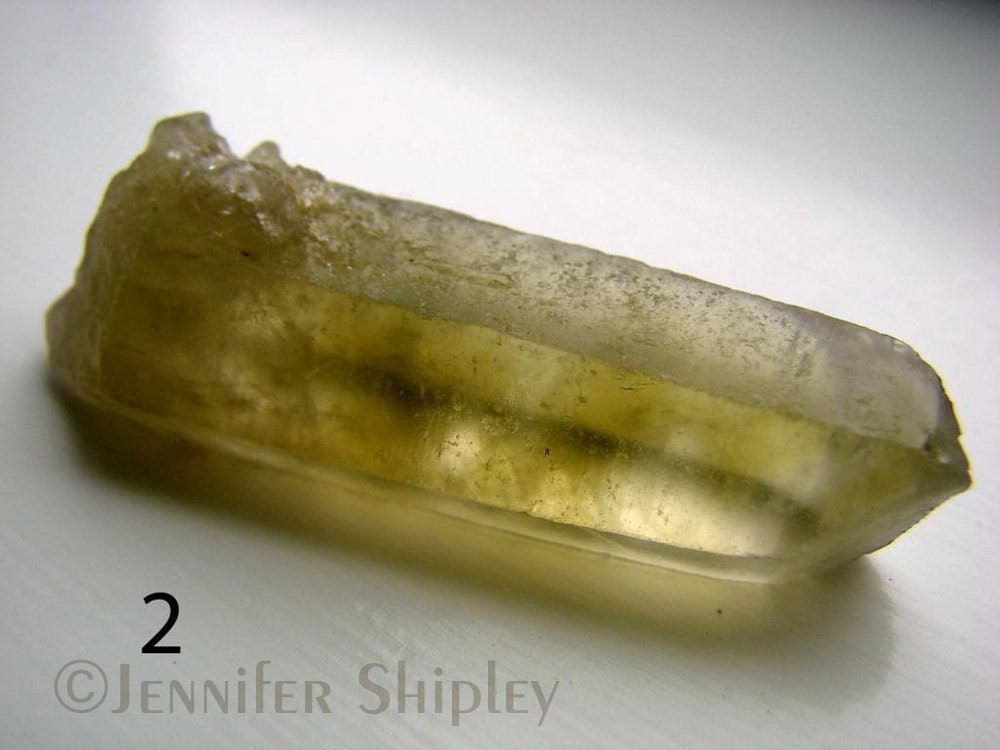
|
| Smoky Lemon Citrine With Straight M-faces - Sichuan, China |
Dichroism: The Coolest Citrine Crystal Test
If you’ve gotten to this point and still can’t tell whether your specimen is lemon citrine or heat-treated amethyst, don’t worry. Some stones fall right on the middle of the yellow spectrum, are champagne-colored, or are cut so you cannot see the crystal habit and color zoning.
One additional trait that can help is dichroism, a subtle color shift visible when a crystal is viewed from different directions. While quartz is not strongly dichroic overall, some natural lemon and smoky citrines can show a weak directional color change, often shifting between yellow and greenish-yellow or smoky tones as the crystal is rotated in the light.

|
| Various Lemon Citrines, Some Smoky, Some Pale |
Amethyst, including heat-treated amethyst sold as citrine, does not display true dichroism. Its color appears uniform regardless of viewing direction. For this reason, a noticeable directional color shift can be a useful supporting clue for identifying unheated citrine, especially when combined with crystal habit and color distribution.

|
| My First Ever Citrine (Heat-Treated Amethyst) |
A simple way to check for dichroism is to view the crystal against a white LCD screen and slowly rotate it. Often natural lemon and smoky citrines will show a subtle directional color shift, while amethyst and heat-treated amethyst remain uniform from all angles.
I will be filming a video on how to do a dichroism test soon, so check back for that, plus for a few more tidbits I ran out of time to complete. I removed all of my links to lemon citrines for sale by various vendors because they were from 14 years ago - this rewrite was long overdue. Hopefully it is a lot easier to get through and the new knowledge I have gained will help you find your perfect lemon citrine crystal. If you are still having issues, you can contact me on Etsy, and I would be happy to help you find one. Also, please visit me on YouTube at https://www.youtube.com/@doodlepunkart where I am teaching rockhounding, geology, crystallography, lapidary and wire-wrapping.

|
| Amethyst Cluster |
Thanks so much for reading.
If you liked this, you might also enjoy:
Red Phantom Quartz and the Important Work of Grounding
Carnelian Metaphysical Properties and Gemstone Information
Black Tourmaline (Schorl) Metaphysical Properties and Gemstone Information

|
| Dog Toothed Amethysts |
One of my favorite quartz websites has a page on citrine that explains the science behind its formation in greater detail: http://www.quartzpage.de/citrine.html

|
| Dog Toothed Brazilian Amethyst |

|
| Dog Toothed Heated Citrine - White Base |


Hello,
ReplyDeleteThank you for your post. It is very helpful for someone whose crystal shopping like me.
According to your post (the picture), then this could be fake citrine:
http://www.ebay.com/itm/171069983679?ssPageName=STRK:MEWAX:IT&_trksid=p3984.m1438.l2649
http://www.ebay.com/itm/221277900979?var=520169710334&ssPageName=STRK:MEWAX:IT&_trksid=p3984.m1438.l2649
http://www.ebay.com/itm/190897077624?ssPageName=STRK:MEWAX:IT&_trksid=p3984.m1438.l2649
I already bought this one:
http://www.ebay.com/itm/141030799660?ssPageName=STRK:MEWNX:IT&_trksid=p3984.m1497.l2649
and this one:
http://www.ebay.com/itm/120719982856?var=420031272978&ssPageName=STRK:MEWNX:IT&_trksid=p3984.m1497.l2649
What is your opinion about those 'citrine' on those links?
I live outside US, and I usually shop on ebay (not very familiar with etsy), and please pardon my English.
Thank you in advance. Elvie.
Hi Elvie. Thank you for your comment. Your English is great. I looked at your links. Unfortunately, none of them are natural (aluminum) citrine, though the first strand of beads is quite lovely. All of these links are showing heat-treated amethyst/iron citrine, not natural (aluminum) citrine. You can tell by the amber color. Also, the tumbled stones have a lot of white. Aluminum citrine doesn't have much white at all - the lighter areas in the real thing are mostly clear, not an opaque white.
ReplyDeleteThese crystals will not have the same metaphysical properties as aluminum citrine, and are not self-cleaning, so you will need to cleanse and charge them regularly if you are intending on using them for metaphysical purposes. I do recommend getting real citrine if you are needing a stone for manifestation and activating the solar plexus chakra. I'm sorry I couldn't give you better news. Feel free to contact me if you have more questions or if I can do anything else for you. :)
Thanks,
x0jen
Hi,
ReplyDeleteI'm just wondering if it's real citrine.
http://www.ebay.com/itm/380749960232?ssPageName=STRK:MEWAX:IT&_trksid=p3984.m1423.l2649
It's not cheep. It does have some white on it. It doesn't look orange though. I wonder if they have come up with a new method to counterfeit the real stone. A lot of Chinese sellers have citrine on ebay which looks OK but I doubt it's real considering everything is made and faked in China. Thank you.
Hi. Yes. This is a nice smoky citrine. Sorry that it has already sold.
DeleteFYI: China is not a big supplier of heat-treated amethyst. The majority of HTA comes from Brazil. China however has a few places that produce real citrine. Sichuan is one of them.
I feel I have to correct you on something. The majority of crystals coming from China are actually genuine, though there are some fakes and mislabeled items. Central Asia is actually rich beyond measure in rocks, minerals and artifacts. This includes China.
There are fakes and mislabeled minerals coming from everywhere (US included,) not just China. There is actually a lot of misinformation propagated by unscrupulous vendors in the US and Europe, designed to sell their products for a higher price. Slap a fancy trade name on something common, like Auralite 23 or Master Shamanite and people get to sell it for 5 times as much. I find this dishonest. I think things should sell for their actual retail value. I don’t think there is a problem giving something unique and uncommon a name that describes it accurately as long as you don’t then mark it up astronomically higher than its relative rarity in the market can account for. Giving something a descriptive name actually helps shoppers find it more easily. Also, if those who have it use the same name, then it gives power to the buyer, allowing them to comparison shop. I’m all for the smart shopper. But when you name something common a name that doesn’t describe it and instead implies an inflated value because of some supernatural power or some mineral inclusions that are probably not actually present, and you call it “rare”, then that is wrong and it isn’t the Chinese who are the perpetrators of these dishonest acts. Buyer beware doesn’t only apply to China. This is why I feel it is empowering for buyers to educate themselves.
If you want to see some interesting mineral specimens from China, here’s the blog of a Chinese mineral collector/dealer names Chen Xioa Jun, who travels around the country visiting mines and markets. He takes photos of his journeys and posts them in blog form on his site in the "Latest News" section. http://www.chenxiaojun.com/news/list_5_1.html So far there are 9 pages (90 entries.) This is a great place to start learning about what China has to offer the mineral world. He does have some actual mine photos if you read through the stuff. Have fun.
Thank you for your reply. I'm still confused about citrine. My daughter wants it for its metaphysical properties. Some sources indicate that natural Citrine is not common, and what's sold is either heated amethyst or quartz. I think it's not too hard to spot the heated amethyst. What about quartz? Internet photos confuse me even more. I have even found a shiny looking Citrine on eBay for over $200. As for the Citrine from Chinese sellers, they look beautiful - I didn't know they mined them there. That's why I was sceptical since most sources mention Russia and Brazil. My intention is to get my daughter the real thing. Thank you for your help. Any more advice is always appreciated.
ReplyDeleteNo problem. You are not the only confused person. :) I am sure there are many other people with the same questions. Citrine and heated amethyst have different healing properties, and most of the time when books and web pages list those properties they do not specify which stone they are talking about. They feel completely different. Heated amethyst feels more like amethyst with sort of a fire energy overtone. Citrine doesn't feel fiery at all, but more air to earthy air, depending on how smoky it is. This is just a little window into their differences.
ReplyDeleteBrazil is a major source of amethyst, which is why it is also the major supplier of heated-amethyst. I have seen some "iron-citrine" from Brazil that was actually heated by nature to be citrine. It's rare and pretty cool, but its properties are closer to heated-amethyst, because that is what it is. As for genuine aluminum citrine, some does come from Brazil too. The Russian stuff is beautiful. I think it's mostly from the Ural Mountains which is mined out, so only old stock is available. There are a couple of places in Africa (Congo and Namibia.) You can also find some from Madagascar, US, Kazakhstan and very rarely from the Alps. BUT China is the biggest source of the real stuff that I know of right now. They are mining it NOW. I am stating this purely from my own experience and research. I've found more from China than the rest of the world combined...and the color of the Chinese ones is EXCELLENT!!! There are many crystals that are almost green...very very neat stuff. And the prices are much lower too, because it is available now. I imagine when it's all mined out, the price will match citrine from the rest of the world
I'm not sure what you are asking about quartz. Perhaps you are confused by some folks that use the word in the listing and others that don't. Citrine and Amethyst are varieties of quartz, as is smoky quartz, tiger's eye, prase, aventurine, agate....so that is why you see it in some listings. I hope that is what you were wondering. Or were you asking about lab created quartz or smelted quartz. If so, let me know and I'll address that.
As for the $200 price tag, I'd have to see the crystal to know for sure, but I have seen a lot of price variation. If it was faceted, that could be one reason why. Faceting is an art in itself so those stones do cost more. If it is a polished crystal with a perfect man-created termination, it shouldn't cost much more than most raw crystals, and many raw crystals are worth much more than a polished one if they are in good condition. Rough (broken pieces) or tumbled nuggets should be the cheapest. A $200 would have to be either faceted, very large or pretty spectacular in shape or clarity in its raw form (not polished) to be worth that.
For healing purposes, a raw crystal with the original termination intact is the best (not a polished termination.) You should be able to get something nice for her from China for under $25. And if you want to spend more, expect the stone to be really nice or large or with excellent intense color.
I do have more citrine. Whenever I put it up in my shop it sells so quickly. Sorry. If you want me to put up a custom listing for you that nobody else can buy, I can do that through my etsy shop. Sometimes I can give folks a better deal that way, if there is less work involved on my end. Basically the less work I have to do, the better the price, so to help save time, you could tell me a price range and any particular qualities (shape, size, phantoms, color....) that you are hoping to find, then I can pick your stone. You would have to make a log in and send me an etsy convo, and I could take it from there. (I accept paypal and credit cards.) Otherwise, I'm always adding more citrine to my shop and have even got some really enormous crystals coming up, but they do go really fast.
Oh also, a "mined out" location can also raise the price. Also, just knowing the exact mine location raises the price, because most serious collectors do not buy pieces that do not have an exact mining location, and many of them believe a stone is worthless without that. Most of the crystals that come from China do not have an exact mining location, which significantly lowers their prices. But most rock shops that I have been to are filled with stuff that has no location attached to it.
ReplyDeleteHi Jennifer,
ReplyDeleteFirst of all, thank you very much for clearing the issue - I nearly bought burned amethyst a few days ago. Since I read your article I have my eyes wide open ;)
You have mentioned China - I have found this page here: http://www.alibaba.com/product-gs/608171701/Raw_small_citrine_crystal_stone_Rough.html
It looks like this citrine is a natural one - it has the shape, the greenish colour and transparency; or am I wrong?
Regards, Diana
Hi Diana, It's hard to say with any certainty because this is not a typical shape for citrine or amethyst. This doesn't mean it isn't. BUT there are a lot of amethyst crystals coming from China and Brazil right now that are atypical. They are not the dog-toothed shape of the typical amethyst from a druzy. These are multiple terminated elestials. Here are some examples:
DeleteFrom China -
https://www.etsy.com/transaction/150148639
Brazil -
https://www.etsy.com/transaction/102988601
https://www.etsy.com/transaction/135657050
https://www.etsy.com/transaction/76849875
Notice that these do not have a pale point where they were attached to a matrix, nor are they the dog-toothed shape.
BUT it looks like there are areas in your crystal that look smoky. Smoky colors are lightened or completely removed by the process of heating, so there is a chance that this one is real, but I can't say for sure with any certainty.
Something that worries me is the amount of crackling in this crystal. This is something that happens when quartz is heated to a high temperature. As for the price, I cannot see it, but a high price doesn't necessarily mean it is real. Some folks inflate their prices just because they see other prices out there that are high. Also, some amethyst will turn greenish when heated to somewhere around 950 degrees f. This is called prasiolite or green amethyst. I've read they also irradiate it, so this could cause smoky color to reappear.
If you are after metaphysical properties, and since the price is not cheap, I would chose a different stone. There are lots out there. I've found a bunch on Ebay from China under the name, "lemon quartz", "yellow quartz" and "citron quartz." Good luck.
Great article, thank you. I was wondering if you might clarify if the following are fake or real citrine, as I'm looking for the stone for its metaphysical properties as well :)
ReplyDelete-https://www.etsy.com/listing/129155216/handmade-14kt-gold-fill-wire-wrapped?ref=sr_gallery_7&ga_search_query=natural+citrine&ga_view_type=gallery&ga_ship_to=US&ga_search_type=handmade&ga_facet=handmade%2Fjewelrynatural+citrine
-https://www.etsy.com/listing/165846287/raw-citrine-necklace-natural-citrine?ref=sr_gallery_24&ga_search_query=natural+citrine&ga_view_type=gallery&ga_ship_to=US&ga_page=2&ga_search_type=handmade&ga_facet=handmade%2Fjewelrynatural+citrine
-https://www.etsy.com/listing/160635211/natural-citrine-crystal-and-smokey?ref=sr_gallery_41&ga_search_query=natural+citrine&ga_view_type=gallery&ga_ship_to=US&ga_page=2&ga_search_type=handmade&ga_facet=handmade%2Fjewelrynatural+citrine
-https://www.etsy.com/listing/168558349/xl-natural-smoky-citrine-phantom-crystal?ref=sr_gallery_4&sref=sr_f3fdab3408987c2aaedd33cc20b8a0c57e017baa9f6f12208a4e2fc3b11f4d89_1384975699_14724377_natural&ga_search_query=natural+citrine&ga_view_type=gallery&ga_ship_to=US&ga_page=3&ga_search_type=handmade
-https://www.etsy.com/listing/167528328/natural-citrine-druzy-crystal-pendant?ref=sr_gallery_27&ga_search_query=natural+citrine&ga_view_type=gallery&ga_ship_to=US&ga_page=3&ga_search_type=handmade&ga_facet=handmade%2Fjewelrynatural+citrine
-https://www.etsy.com/listing/168982867/large-huge-statement-pendant-natural?ref=sr_gallery_25&ga_search_query=natural+citrine&ga_view_type=gallery&ga_ship_to=US&ga_page=3&ga_search_type=handmade&ga_facet=handmade%2Fjewelrynatural+citrine
-https://www.etsy.com/listing/29525034/wire-wrapped-pendant-in-14kt-gold-filled?ref=sr_gallery_33&ga_search_query=natural+citrine&ga_view_type=gallery&ga_ship_to=US&ga_page=10&ga_search_type=handmade&ga_facet=handmade%2Fjewelrynatural+citrine
-https://www.etsy.com/listing/128184305/natural-gemstone-citrine-pendant-with?ref=sr_gallery_23&ga_search_query=natural+citrine&ga_view_type=gallery&ga_ship_to=US&ga_page=18&ga_search_type=handmade&ga_facet=handmade%2Fjewelrynatural+citrine
-https://www.etsy.com/listing/128184305/natural-gemstone-citrine-pendant-with?ref=sr_gallery_23&ga_search_query=natural+citrine&ga_view_type=gallery&ga_ship_to=US&ga_page=18&ga_search_type=handmade&ga_facet=handmade%2Fjewelrynatural+citrine
-https://www.etsy.com/listing/100387530/citrine-citrine-gemstone-vintage-and?ref=sr_gallery_13&ga_search_query=real+citrine+pendant&ga_view_type=gallery&ga_ship_to=US&ga_search_type=handmade&ga_facet=handmade%2Fjewelryreal+citrine+pendant
Sorry I know it's a lot of photos, but I'm finding it hard on etsy to differentiate between some of them!
Thank you so much
-Heather Marie
Hi Heather. Thank you for reading my article. :) I've had a chance to review your links and here are my conclusions:
Delete#1 Yes. It is real, natural (unheated citrine.) Notice the long m-faces or sides that lead to the termination.
#2 Item doesn't exist anymore. It may have expired, so perhaps it will get renewed and reappear.
#3 Yes. It's the real deal and absolutely GORGEOUS!!!!!!. This is an excellent stone and it's color is surprisingly honey/amber, which is not the typical lemon color of the stuff from China. Looks like Africa, perhaps. Or maybe Brazil.
#4 Yes. Nice smoky citrine. "Smoky Citrine" is a good search term to type in to etsy for the real thing.
#5 No. Dogtooth shape with no m-faces, whiter base (and other areas), lots of cracks caused by heating and even a little bit of amethyst left on one side.
#6 No. Dog-toothed shape, whiter base and areas and lots of crackling from heat.
#7 No. White areas and lots of crackles from heating.
#8 No. Dogtoothed with pale base and lots of crackles from heating.
#9 Same item as #8.
#10 No. Dogtooth, crackles, white and weird color.
Great job on finding the 3 that are real citrine! x0jen
Would you happen to know if this citrine is real or fake by chance?
ReplyDeletehttps://www.etsy.com/listing/107053068/citrine-necklace-november-birthstone?ref=sr_gallery_34&ga_search_query=citrine&ga_order=most_relevant&ga_view_type=gallery&ga_ship_to=US&ga_search_type=handmade&ga_facet=handmade%2Fjewelrycitrine
Hi Heather. I'm sorry. It is not. Notice how the "citrines" are the same shape as the amethyst? This shape is called dogtoothed. It means that there are no sides (aka. m-faces) and is composed of a termination connected directly to the base (which is actually another termination that's grow was inhibited by other amethysts growing on the same matrix (druzy) and whose tip was buried inside the matrix, so it was broken off. The color is really brownish. There are a lot of crackles made from heating the crystal so hot that it fractured throughout. The base is an opaque white. This is definitely heat-treated amethyst.
DeleteHello,
ReplyDeleteThank you so much for your article. I have been doing some research myself on crystals for the past few months and I am looking to buy a few things:
1) pure natural rose quartz balls
2) raw natural Amethyst (purple)
3)raw natural Citrine
I am forwarding you a few links. Please let me know if these are fake or real. Let me know if links A, B and H are not clear (pictures taken on my phone). I could perhaps send them to you via email?
Amethyst (purple):
a) https://dub115.mail.live.com/att/GetAttachment.aspx?tnail=0&messageId=164eb2ce-6290-11e3-ae69-00215ad71362&Aux=4|0|8D0C4B3FEA53570||0|0|0|0||&cid=e5930f5ed14947bb&maxwidth=220&maxheight=160&size=Att&blob=MHxJTUctMjAxMzEyMTEtV0EwMDAwLmpwZ3xpbWFnZS9qcGVn
b) https://dub115.mail.live.com/att/GetAttachment.aspx?tnail=0&messageId=2a8ad96b-6290-11e3-8f6b-002264c2c1bc&Aux=4|0|8D0C4B410F096C0||0|0|0|0||&cid=e5930f5ed14947bb&maxwidth=220&maxheight=160&size=Att&blob=MHxJTUctMjAxMzEyMTEtV0EwMDAyLmpwZ3xpbWFnZS9qcGVn
c) https://www.etsy.com/uk/listing/170782743/amethyst-cluster-crystal-bed?ref=favs_view_1
d) https://www.etsy.com/uk/listing/170446856/raw-amethyst-crystal-cluster?ref=favs_view_3
e) https://www.etsy.com/uk/listing/152242012/amethyst-cluster-gemstone-crystal-75mm-x?ref=favs_view_12
f) any of these ? http://www.crystalage.com/online_store/amethyst-clusters-1128.cfm?displaySortType=price_low
Rose quartz :
g) https://www.etsy.com/uk/listing/171025597/rose-quartz-stone-sphere-rose-quartz?ref=favs_view_5
h) https://www.etsy.com/uk/listing/151605238/rose-quartz-ball-carved-stone-sphere?ref=favs_view_14
i) http://www.crystalage.com/online_store/rose_quartz_medium_crystal_sphere_648960.cfm
Real Citrine :
j) https://dub115.mail.live.com/att/GetAttachment.aspx?tnail=0&messageId=21d1667d-6290-11e3-88b6-00215ad99f00&Aux=814|0|8D0C4B408FD8630||0|0|0|0||&cid=e5930f5ed14947bb&maxwidth=220&maxheight=160&size=Att&blob=MHxJTUctMjAxMzEyMTEtV0EwMDAxLmpwZ3xpbWFnZS9qcGVn
k) https://www.etsy.com/uk/listing/172111955/smoky-citrine-natural-terminated-crystal?ref=favs_view_2
l) https://www.etsy.com/uk/listing/150648958/natural-citrine-quartz-rough-raw-large?ref=favs_view_6
m) https://www.etsy.com/uk/listing/170615079/raw-citrine-crystal-specimen-35-carats?ref=favs_view_7
n) https://www.etsy.com/uk/listing/169063880/raw-citrine-crystal-specimen-65-carats?ref=favs_view_8
o) https://www.etsy.com/uk/listing/170985582/raw-citrine-crystal-specimen-twin-40?ref=favs_view_9
p) https://www.etsy.com/uk/listing/170469532/raw-citrine-crystal-specimen-50-carats?ref=favs_view_10
q) https://www.etsy.com/uk/listing/167074276/citrine-crystal-raw-cluster-orange?ref=favs_view_11
r) https://www.etsy.com/uk/listing/122219165/citrine-cluster-gemstone-crystal-110mm-x?ref=favs_view_13
s) https://www.etsy.com/uk/listing/170868123/citrine-crystal-cluster?ref=favs_view_15
t) https://www.etsy.com/uk/listing/170440266/citrine-crystal-cluster-143?ref=favs_view_16
http://www.crystalage.com/online_store/citrine-healing-crystal.cfm
Few questions/concerns :
-On the Etsy website, no matter what item you are looking at, it always says ‘only one available in stock’. I find that very strange and suspicious …
-Does it matter how big the stone is? The bigger, the better healing powers?
- How to do activate or energise these crystals? How do you cleanse them?
Hello Pooja. Thank you so much for you message. I will do my best to answer all of your questions. This is going to be long, so I will answer the questions first in two posts, then address all of your specimen links in a third posting. First I am going to address your questions about etsy. Etsy is a site that features individual sellers who each have their own shop. The items are either handmade, vintage or supplies. Many items available on etsy are one-of-a-kind, so there is only one in existence. If your listing says, “only one available” that means you are looking at the exact crystal (or item) that you would be purchasing. Once that is sold, it is gone forever because there is not another exactly like that in the whole world. I do not send an item that is similar to the crystal or pendant in the photo. I send THAT EXACT ITEM. When it is sold, I have to take photographs of a different crystal, take measurements and weight and create a new listing for the new item, which is also one-of-a-kind.
DeleteSome venders on etsy take a photo of an item or a group of items, and list (for example) “10 available” so you can purchase up to 10 similar items. You won’t get exactly what you see in the photos. You will get something similar. But many vendors do not do that. Since crystals are very personal and each one is unique, I think that there is more benefit to being able to pick your exact crystal, even if it is more work for me to sell them that way. I hope that answered your question.
And to ease your mind, buyer feedback is extremely important for each etsy seller. Each seller aims for 100% positive feedback. This creates a lot of seller accountability, making it very important to us for our customers to be extremely happy with their purchases. That is part of what makes etsy a very safe place to shop. I have only had one bad experience with something that I purchased on etsy, however I filed a claim and etsy facilitated a refund for me, then they deleted that seller’s account because the vendor did not cooperate with resolving the matter. I hope that makes you more comfortable with supporting these small businesses. If you ever feel doubt about a vendor, simply look at their feedback ratings. You should expect that it is 100% positive. Also, take a moment to read what other buyers have written about the seller. (When you are looking at an item, you can see a tab with yellow stars on it underneath the item photos. Click on that to read the customer review for that person.)
About size: Size does not matter for healing yourself. If you want the crystal energy to fill up an entire room, office or building, affecting a lot of people, you will need a larger stone (three pounds or more.) OR you can boost a crystal’s energy by placing it on a selenite spear. Not only does that make the energy stronger after you remove it, while it is on there it can project the energy out to fill up a room or even a building (depending on the size of the selenite.) For personal use on your body, you do not need a large stone. Some of the strongest crystals I have felt have been smaller about 1 inch. (Though I would say a 3 mm crystal is too small to do your whole body.) The size doesn’t affect strength of energy; it affects how far out the energy reaches.
DeleteCrystals do not need to be “activated” per se. They do need to be cleansed and charged though. They can get dirty and tired. I like to use selenite for cleansing and charging everything because it cannot harm any stone. Other methods like sunlight, water, smoke, can harm some items. For example, sunlight will bleach citrine, amethyst, rose quartz, smoky quartz, fluorite and can change the color of many other minerals. There are many minerals that are water soluable (selenite, reibekite, Chalcanthite…) Smoke will tarnish metal in any jewelry, so I don’t recommend smudging with incense for gemstone jewelry. I cleanse and charge selenite and clear quartz in direct sunlight. Everything else I either place on a selenite spear, or I point a selenite spear at a raw, clear quartz crystal (with its original termination) which is pointing toward the rock or mineral I want to cleanse or charge. (All crystals are in one line, like an arrow.) The latter method is the quickest because the quartz amplifies the selenite, which is pure light energy. It takes about three minutes with this method to cleanse a stone. After that it begins to charge. Charge it for at least three minutes, but you can go as long as you like. I have revived an old, tired and bleached out amethyst by putting it in a dark wooden box of selenite for 1 month. Some of the purple color even came back.
Programming is another subject entirely. I’m not sure if that is what you meant when you said “activating.” Programming is only necessary if you want to assign a specific purpose to a crystal. This is done with your intention. You can focus on what you want it to do and then say it out loud while tapping a face of the crystal. Repeat this for all faces of the crystal (on the body and on the termination) except for one face. (I like to leave one face unprogrammed to allow there to be a bit of openness for serendipity.) Do not change your crystal’s programming frequently. This will “tire” it out, requiring a break period that is best spent in a dark box of selenite, or buried in the ground.
Now let me address your questions about the specimens you are interested in. I was unable to view items A, B and J because they are items located inside your email account and not web addresses that I can view without logging in to your personal account. If you would like to email them to me, please feel free to attach them to a conversation to me in my etsy shop. My address is http://www.etsy.com/shop/doodlepunkart
DeleteAs for your other links, here are my conclusions:
Amethyst –
c. Yes. It is real.
d. Yes. Real
e. Real
f. Yes. All are real.
All of the amethysts you posted are examples of the most common form of amethyst – the geode cluster. The purple crystals are the amethyst and the rock is the matrix that it grew on. Most single crystal amethysts have been broken off from this matrix.
Rose Quartz –
g. Yes. Real. I can see fractures with iron staining them yellow.
h. Real. Lots of flecks and fractures.
i. I can’t tell. The photo quality is poor. There isn’t enough clarity. I cannot see any inclusions/flaws.
Natural crystals have flaws. Most have flaws that are visible to the naked eye. Even facet grade crystals have flaws. They cut the faceted gemstones from sections of stone where the flaws are not easily visible to the naked eye. These are few and far between. Anything that is the size of any of these spheres will have flaws. If you see crystal balls that are perfectly clear or one solid color with no glittery flecks, fractures, variation in color or clarity, it is probably glass. The first two links (g and h) have plenty of flecks and fractures. The third one (i) is just solid, one color with absolutely no visible texture. This looks to be a standard (and highly retouched) photo and not a photo of the item you will get. Because I cannot see the item they will send AND the photo looks so fake, I would never buy it.
Citrine:
k. Yes. It is real.
l. Yes. Real. I believe I have a link to this person’s citrine at the bottom of my article.
m. Yes. It is my item from my shop. All of my citrine is real, unheated, untreated citrine.
n. Yes. It is my item.
o. Yes. My item.
p. Yes. My item
q. No. This is heat-treated amethyst, NOT natural citrine. Notice how it looks just like the amethyst geodes you posted? They just took one of those and heated it to about 800degrees farenheit and presto. Instant, “citrine.”
r. No. This is heated amethyst too. Notice as well how it is much darker at the tips? This is another common trait of amethyst grown on a geode.
s. No. Same thing. You can really see how white the amethyst gets as it gets closer to the matrix rock.
t. No. Fake Fake Fake. You will never see real citrine that burnt brown color.
The last one didn’t have a letter. It is probably real, though it’s hard to be 100% sure because it is photographed on black so I can’t see the color well. The shape is not like amethyst at all. This laser shape is found in genuine citrines. My only problem is the black background because it does not make it possible for me to be 100% sure that it is not iron-stained quartz. BUT I would say I’m at least 100% sure it is not heated amethyst. And the second photo (the one with the packaging) looks real. Just so you know, this is an example of a vender who sells you an item that looks like the photo, not the actual crystal in the photo.
Good luck and let me know if I can do anything more to help you. ~Namaste.
Hi miss jennifer! I'm a little confused. My mom bought me a bracelet from a feng shuu expert i guess and she said it's made of citrine. Could you help me if this is a real one?
ReplyDeletehttps://plus.google.com/app/basic/117157822326590280401/posts?cbp=13qdjhbtc5wvb&sview=25&cid=5&soc-app=115&soc-platform=1
Hi. I'm sorry. I missed your message. I wish I could give you a definitive answer. It is really tricky to tell with things that are not raw and don't exhibit the telltale signs of heated amethyst. If it had a slight subtle greenish hue, then I'd say definitely it's real, because I don't see any obvious signs of amethyst or heating. The color is similar to some heated amethyst and also to real citrine from the Congo (tinted sort of amber.) There is not crackling or banding common among lower grade heated amethyst, so in any case, it is high grade whatever it is and it is quite pretty. My suggestion is to use it. If you feel it is giving you the energy you want, then great. Keep it out of the direct sunlight, like you would amethyst, and cleanse it regularly. I like selenite for cleansing my light sensitive stones. (Citrine is light sensitive too, just not as bad.) If you feel like the energy dampens or darkens quickly, then I would lean towards amethyst, because citrine rarely needs to be cleansed, and while it is stronger when charged regularly, it doesn't need it as often as amethyst. I hope I was able to help you.
DeleteHello my name is Andrea.
ReplyDeleteI've read your post on Citrine and love it! I am searching for Genuine Citrine and was wondering if you could tell me if these are genuine:
https://www.naturesforyou.com/shoppingcart/products/Citrine%2C-natural-%252d-tumbled-%252d-medium.html#.UtTGW_Uo4uo
Thank u so much for your help!
- Andrea
Thank you, Andrea. I am glad I can help. I am sorry. This is heat treated amethyst. You can tell by these traits:
DeleteColor - yellow is a bright orangish yellow like yellow food coloring. Citrine is never that color, even when it does have a touch of orange tinge.
Opacity - The opaque white is just like amethyst. I've never seen an opaque white even remotely like this in real citrine. There can be some opacity, but usually it is less opaque, it is created by a white mineral or a faden line, not milky quartz and it will still have the same hue as the rest of the stone. This white is lacking hue. This is a very common look in heated amethyst.
Texture - crackling is indication of heating. The cooling process was probably a bit fast so the cracking is very extreme in the top photo. Think of crackle agate and fairy crackle quartz and how it has the exact same texture. This is created by heating and then rapid cooling.
What I have stated is based on the photo at the top that you can click to enlarge. There is a photo at the bottom too that is such a weird color and poor quality that I cannot be sure what I'm looking at, but it almost looks like different material and there is not the same crackle texture or opacity that is present in the top photo. However, there is a little banding, like banded amethyst in a couple of the stones, and the photo has a look that seems to be highly corrected by someone with very poor photoshop skills, using the "Adjust Hue/Saturation" setting. They simply moved the slider bar to the right. Based on the photo of the fake stuff at the top and the weird, altered photo at the bottom, I would not buy it.
If you want real citrine, I've attached a number of links to other shops that sell it, and I sell it in my own shop. If you are looking for something in a particular price range, just convo me. I've got a very broad selection of different grades including some rough stuff that just came in, though most of my stuff is whole, raw crystals. However, I do have spheres in my studio as well. http://www.etsy.com/shop/doodlepunkart
Wow. Thank u so much! I'll be purchasing from your store shortly! Thanks for the info. I definitely can see the difference.
Delete- Andrea
I'm also want to buy real stones (sorry for my english) and I know ametrine is also a veriety of amethyst. I found this website selling expensive ametrine bracelet, can you tell if it is real? http://www.gyogyitokovek.eu/ametrin-karkoto-ametiszt-citrin
ReplyDeleteThey say its natural and some beads are even half yellow, half purple. Is it a proof?
Hi Sarolta, I'm sorry I do not know if this is real. Unfortunately it is really hard to tell if a crystal is real when it has been cut into stones; and these photos are very low resolution, so I can't zoom in to even look for the signs that a stone has been heated. They are pretty. Energetically, though, I doubt there is much difference between ametrine, amethyst and heat-treated amethyst, since ametrine is a type of amethyst, not a citrine. The yellow color in ametrine is made by a higher concentration of iron, not by aluminum and lithium, like in true citrine, so it is not going to have the same properties as true citrine.
DeleteI think the beads are really very pretty. I can not advise you whether to buy them or not. I suppose you could check their online reviews and also their return policy, so that if you do buy them and when they come you don't like them, you will be able to return them. I know that some online companies can be very difficult to get refunds from, so check the reviews to see if anyone had problems with that company.
If you want to know more about ametrine, check out this page: http://www.quartzpage.de/ametrine.html
Good luck,
x0jen
Hi!
ReplyDeleteYour site is really great!
I have a question. I have a Tibetan Citrine sphere that looks almost identical to your photo of your collection of citrine, its the photo called:
'Geniue Pale, Smokey...'
I know citrine comes mostly from Brazil but is Tibetan Citrine real? It looks a pale yellow.
Do you know of any good sellers who sell Natural Citrine Spheres? I tried your links on etsy but no luck.
The best I could find was a site called Mineral Miners but all the good pieces are sold out.
You mention you sell them? Would you be willing to email me? Looking for a natural citrine sphere 40 mm roughly.
Henrytarot@gmail.com
Thank you for your time.
Hi Henry. Thank you for your message. You’ve got some good questions and bring up something that I should actually explain in this article, which I will do when I rewrite it. Most real citrine doesn't actually come from Brazil. Most heated-amethyst comes from Brazil. Brazil has an abundant supply of many varieties of quartz, and does have some genuine citrine, but (from what I’ve read and seen) not significantly more than China, Madagascar, Russia and Congo. However, Brazil and bordering Uruguay are the world’s largest suppliers of Amethyst, which is why people say that Brazil is the largest supplier of citrine. They do not know that most of the Brazilian "citrine" on the market is actually is actually heated-amethyst. SO, my point is, just because a citrine doesn’t come from Brazil is not a reason to think it isn’t real.
ReplyDeleteSo now the question remains, is your Tibetan citrine sphere real? It could be. It’s hard to say though, especially without seeing it in person. When you can see the natural crystal shape, it is fairly easy for me to tell for the most part. When it is cut, polished, formed into shapes, we have to rely on coloration, and even then there is a middle of the road where it’s pretty tricky. If is was smoky, then you could assume that it hasn’t been heated, because smoky goes away at much lower temp that amethyst requires to turn yellow. But you say the color is pale. Pale could be quite good. Usually heated amethyst is brighter or orange, amber or brown, though it can be a little honey like some real citrine. There is another way to tell, but it’s quite difficult. True citrine is slightly dichroic. For citrine, the color intensity varies slightly depending on the direction polarized light shines through it in relation to your eyes (or when looking at it through a polarized lens. It is very, very subtle though and you have to get it at just the right angle to see this. I have noticed my more strongly colored citrine spheres and the smoky citrines there is one direction where it looks a lot more saturated, but I can’t really see that on the lighter ones. Heated amethyst will not do this. Most laptop monitors have polarized light, so you can go to a white page and pump up your brightness to the top, then look at your sphere in front of the white screen. Turn it in every direction. See if you can see any slight variation in color intensity. Don’t expect it to be obvious. It is subtle. If you can find that, then your citrine is the real deal. Hope that helps.
Also, I do have a few citrines from Tibet, so this is not a location void of citrine. Mine are pretty smoky though. If you are looking for more, my supplier had a one time only stock and I purchased the entire lot from him, so I do have some of those left. That is them in the photo. I'm not really wanting to sell them all off though, because they were purchased for making pendants and I don't know if I'll ever find them again. BUT I would sell you one if the size is right...I can also take a look at my other vendors for you, if mine isn't big enough. I think 22mm is the largest I've got and I'm almost out of those. Just convo me on etsy.
:)
x0jen
Ok, I will send you a msg on etsy.
DeleteI will also send you a photo if I can. At first I thought my Tibetian Citrine was real but doing some research it also might be Honey Calcite.
I know a lot of people say heated amethyst is used as 'fake' citrine but also Honey Calcite I've seen passed off as citrine.
My Tibetian Citrine sphere 30mm cost me $30.00 off ebay
It looks almost like this:
http://www.ebay.com/itm/54-mm-AAA-Rainbow-Honey-Calcite-Sphere-Clear-Crystal-Ball-/141213342961?pt=LH_DefaultDomain_0&hash=item20e0f89cf1
and this:
http://www.ebay.com/itm/RAINBOW-NATURAL-PRETTY-CITRINE-QUARTZ-crystal-SPHERE-BALL-120g-G3-/301117057808?pt=LH_DefaultDomain_0&hash=item461bf9ab10
Anyway, will msg you on etsy.
Thanks for your quick reply. :)
Hi Jennifer,
ReplyDeleteI'm confused about something you wrote. You said at one point:
“Citrine's yellow color is created by aluminum and lithium trapped inside the crystal structure that have been exposed to naturally occurring radiation. It is created in almost identical circumstances as smoky quartz with the same elements present.”
and later you said:
"• Natural Iron Citrine - Yellow crystals colored by (irradiated) iron built into the crystal lattice which were exposed to heat from a natural source at some point during its formation. These would have been amethysts if they had not been exposed to natural heat. This is a very rare occurrence. Healing properties are similar to amethyst or heat-treated amethyst.
• Aluminum Citrine, or simply Citrine. Contains no iron and doesn't require heating for its yellow color. Healing properties are very different from those of amethyst. It is a true manifestation stone which activates the solar plexus chakra. This is a very rare stone."
My question is: when you say that citrine is not far from being a smoky quarts, are you referring to "Natural Iron Citrine" or "Aluminum Citrine"?
Thanks for the clarification.
Michelle
Hi Michelle. Thank you for asking. Let me see if I can make this simpler. "Iron citrine" is always heated-amethyst. 99.99999% of the time iron citrine is artificially heated, not actually natural It is my personal opinion that when heated by man, this is not citrine. When it is heated by nature at some point in its growth, then I will call it "iron citrine" but this is extremely rare. It's properties are similar to amethyst and heated-amethyst, not citrine (Al:Li).
ReplyDelete"Aluminum citrine" is the naturally yellow stuff that hasn't been heated. It is the citrine that most metaphysical properties are written about. It is a true manifestations stone. This is the citrine I sell in my shop and am teaching you how to identify. It is sometimes sold as lemon quartz.
Smoky quartz is also colored by aluminum and lithium too. Citrine (Al:Li) and smoky quartz are chemically very similar, and are often found together.
I hope this clarifies.
I need to clarify something. I have read that on some occasions smoky quartz will turn more yellow with careful heating. I do not believe this is possible unless it is a smoky citrine to begin with though. In my experience, I have only had two citrines change color from the heat of the molten metal when making my pendants, and they just became very pale. (It is necessary for them to heat at least a little for the metal to flow.) I've made multitudes of pendants and never has smoky quartz EVER turned into citrine. In fact, I don't usually even notice a color change at all, except an occasional lightening if I let the stone get too hot. Usually things explode before they change color, so heating is definitely an art and it causes fracturing which can be seen by the naked eye.
DeleteAlso, (on a side note) I have read that if the proper minerals are present (the proper ratio of Al:Li) a clear quartz can become citrine when irradiated. Most cases though, clear quartz will only become smoky quartz with irradiation and the color is usually very dark.
I'm only telling you this because there are some exceptions to the rules. If heating lightens up the smoky in a smoky citrine, it is still chemically citrine and NOT heated-amethyst so it's properties will be citrine.
One thing I'd like to do is compare irradiated smoky with natural smoky to see if I can feel a difference. I have heard of one woman who can tell the difference...but I digress.
Thanks, Jennifer, that helped!
ReplyDeleteMichelle
Wow, how ignorant I was. I thought the most beautiful citrine would be more yellowish, and I didnt know the orange golden yellow was usually heated amethyst.
ReplyDeleteSo I had bought this pendant from some german seller and is silver with a small amethyst and a bigger citrine that is kinda pale just a little lemonish yellow and I was so disappointed and wondering if was a real citrine (since every site almost show the heated orange amethyst as "citrine") and I was bugged. You showed me that the totally opposite is true and highly likely this is actually citrine... How bad is being ignorant and influenced by media!
Thank you so much :)
Yes. There are a lot of people that consider "citrine" as a color, not as a naturally yellow variety of quartz. And there is a lot of confusion about what makes the color (iron, vs aluminum and lithium.) So much misinformation is re-posted over and over again, and nobody seems to take the time to do the research and study scholarly documents in order to know the truth before they write about it. :( As for your crystal, it is hard to say. I'm wondering, is it already faceted, or is it a raw stone? Also, by lemon yellow, do you mean it has a slightly greenish tint, like a lemon that is almost ripe? Or do you mean the color of a very ripe lemon (goldenrod - which has just a tiny hint of orange)? Any slightly greenish hue and it is probably natural citrine. Any orangish hue and it is probably amethyst.
DeleteHi there, i'm a newbie to crystals and recently collected 2 citrine points.
ReplyDeletefrom the pics (link), are they untreated pieces?
http://tinypic.com/m/idx7cj/2
Hi. Because they are already cut, I cannot tell by the shape, but based on the color that came through in the photos, I would say there is a very high probability that these are genuine and unheated citrine. They look kinda greenish and very smoky, so I would say they are smoky citrines. :) I think you made a good choice.
DeleteThanks Jennifer.
DeleteGot them cos of the color too.
Hope they are not irradiated types if treated..
Regards,
Hann
I know of the seller that you are talking about in your addendum, Athena. And, I get the same feeling about the things she sells. There have been many times on Facebook that she has mix labeled items. It sets my teeth on edge that she labels herself as she does, and the prices she asks! The most recent I've seen are 'carnelian' hearts she selling that are a form of banded agates. Frustrating.
ReplyDeleteDanielle
Oh my. Did actually use her name??? Goodness, gracious! :\ I should not have done that.
DeleteI just looked at her hearts. You are correct. Agate. NOT Carnelian. :(
Accidents do happen. Sometimes we make mistakes. There is a lot of info to know and it's quite common for our suppliers to give us inaccurate information. This is why I always educate myself about each new stone before I list it.
Here's the problem I have with this seller. When informed of her error, instead of investigating or asking questions, she basically covered her ears and sang, "LA LA LA LA LA LA LA!" If someone said my item was mislabeled, I would be asking them questions, investigating, engaging them to see why they are saying that to BE ABSOLUTELY SURE that I have not been leading my customers astray. And what is even more troubling is that she TEACHES CLASSES! :( Icky. I have a problem with that.
Hi Jennifer, I was just wondering if you (or anybody else) could please take a quick look at these two citrines. After familiarizing myself with many fake and real citrines, I think these two check all the right boxes. I just need some confirmation from a second person .This would mean a lot to me as my heart has been set on finding real citrine and never have I felt so stupid and disappointed purchasing a deep fried amethyst. I cant even look at it.
ReplyDeleteMany thanks for informing so many people to this cold hard truth. Thankyou. I wish I saw this blog a week ago.
http://tinypic.com/m/iml11f/4
http://tinypic.com/m/iml11g/4
Hi. Thanks for reading. I checked them out and they are real, Al:Li citrine, not heated amethyst. :) Cheers!
Deletex0jen
I'm not sure if my last comment was published - my log in keeps sending me back to a blank page to preview. My apologies if this is duplicated. :)
ReplyDeleteHello,
I love your blogspot about citrine. Very informative!
What do you think of the smoky citrine that has been irradiated, giving it a smoky, light-yellow with a greenish tint? This description also fits of genuine citrine, yet apparently it can also be irradiated smoky quartz.
How can we tell the difference?
Thanks so much!
After reading this I am fairly certain that the little piece of "citrine" I bought at a local metaphysical shop is, indeed, heat-treated amethyst. It's very orange, has a white tip, and while it isn't "dog-tooth" shape (it's narrower than that) the sides are very irregular. I'd been thinking about buying a new piece of (actual!) citrine anyway, and I'd rather get a tumbled piece. There's a site that I've bought a few stones from before that sells both "natural" and "treated" (their words) citrine, here are the links to each:
ReplyDeleteNatural: http://www.exquisitecrystals.com/citrine-natural-tumbled-stones-72-tps
Treated (they do specify it as such): http://www.exquisitecrystals.com/citrine-treated-tumbled-stones-6-cra
I can tell from the pic that the treated citrine is, in fact, heated (tumbled) amethyst, but what about the "natural" citrine, is that genuine, if you can tell?
This comment has been removed by the author.
Delete(dangit Blogspot doesn't give an option to edit comments, so I had to delete and post again w/edit)
DeleteI should add that nearly all the reviews I've read of that site have been very positive.
Thank you so much for making such an in-depth post about natural vs fake citrine. I've been searching high and low for some natural citrine beads to make bracelets with but I am so confused about which are really genuine unheated citrines and which are HTA.
ReplyDelete1)https://www.etsy.com/listing/236897526/free-shipping-genuine-round-citrine?ref=shop_home_active_2&ga_search_query=citrine
2)http://www.jewelrytopia.com/?goods=detail&id=17185
If those are not natural citrine beads, do you know any reliable sources of natural citrine beads or do you have any examples of natural citrine beads?
This is a very helpful post. Prior to this I knew nothing about the two stones, not to talk of the differences.. thanks for sharing.
ReplyDeletewww.lilyofnigeria.blogspot.com
Hi Jennifer,
ReplyDeleteI was wondering if you could take a look at this citrine (link below) listed at Ebay from China.
could you tell me if this is a real citrine?
Thank you very much :)
http://www.ebay.com/itm/456g-Citrine-Quartz-Crystal-Cluster-Smoke-China-JSU54/231897409118?_trksid=p2045573.c100033.m2042&_trkparms=aid%3D222007%26algo%3DSIC.MBE%26ao%3D1%26asc%3D35955%26meid%3D0be129feb675464288ae77f4b243a3ba%26pid%3D100033%26rk%3D4%26rkt%3D4%26sd%3D222072647618
Thanks for the great info. I'm looking for a natural untreated citrine ring and found this on etsy: https://www.etsy.com/listing/209040681/natural-105-carat-citrine-diamond-ring?ga_order=most_relevant&ga_search_type=all&ga_view_type=gallery&ga_search_query=untreated%20citrine%20ring&ref=sr_gallery_8
ReplyDeleteWhat is your opinion? If color is very light can I assume it is real? If not, can you recommend a seller that has rings? Most of your recommendations seem to be for raw crystals and pendants. Thanks so much for any help you can provide.
Aloha,
Pamela
Amethyst does not fade in sunlight over the course of an average human lifetime, and does not need to be kept in the dark.
ReplyDeleteAmethyst does fade in the sunlight, and it can happen quite quickly. It depends on the amount of UV so if your windows have a UV coating, it will filter some of that out and slow that down, but yes, they do fade, and it's not over a lifetime. My favorite amethyst I used to work with turned completely clear in just few (maybe 3) years. I was not in the habit of keeping it on my windowsill either. I did used to cleanse and charge things in the sun though. One day I just realized suddenly it was almost completely clear. If you look the information up, you will see that this is true. There are actually many gemstones that fade in uv light.
DeleteAre all the Amethyst Spheres,that are for sell at www.alibaba.com/FAKE?:
ReplyDeletehttps://www.alibaba.com/product-detail/100mm-natural-amethyst-ball-crystal-stone_60583005929.html
Thank you.
Unfortunately it has been so long since you posted this question that the listing no longer exists. Sorry for my delay. NO. There are a lot of genuine products on alibaba, as there are a lot of fakes, or dyed, or heated... Alibaba represents countless different independant sellers, so it's a crapshoot. There are many good items. There are many not so good items. If you post another link, I would be happy to take a look at it. I am checking this blog regularly again. So sorry I went MIA for so long.
DeleteHello,
ReplyDeleteVery Good Article! :)
I have a link here below to a Citrine Point that I was wondering if you could tell me if you think it is natural and untreated/unheated citrine? ....
https://www.etsy.com/listing/267489651/golden-citrine-channeler-point-w-rainbow
So sorry for my delay, and I apologize but I couldn't tell with that one. The color of the rock it's on is kind of a light warm brown, so it's hard to tell if it's picking up that color, or that is the color of the stone. It's not obviously lemon. And in her hand, I still tell for sure, though it might be a little smoky lemon color. I would say either the photography is showing a warm color cast and the photo in her hand is more accurate (smoky lemon citrine, easy on the lemon), or it is heated. There is no way for me to be sure with that one. I apologize.
DeleteHello,
ReplyDeleteAfter reading your article I noticed the color and shape on my crystal and I have a strong feeling it is Heated Amethyst and not Citrine.
My question is : Do I treat the stone as it has Amethyst benefits or Citrine benefits?
Think of it as a hybrid amethyst for your solar plexus and sacral chakra. Robert Simmons has a section on it in his book next to the unheated citrine section. I apologize that I haven't worked with it much since I started using lemon citrine, but I am adding that to my list of things to play with. :) Cheers!
Deleteeven though it is Heated Amethyst, does it work as an Amethyst crystal and does it have the same Amethyst benefits?
ReplyDeleteHi. It's actually a little different from amethyst, not exactly a yellow amethyst. Chemistry-wise, the heating undoes the affect that the gamma radiation had, so it is a bit of a hybrid crystal. Robert Simmons has a section in his book on it. I haven't worked with it much since I discovered lemon citrine, so I have not written my own guide for it, but perhaps that's something I need to put on my list.
DeleteHi! First thank you so much for this article. Unfortunately I still can't make up my mind on my two pieces of what could be citrine and your help would be very much appreciated.
ReplyDeleteI got these two pieces from a seller (in a market) from Madagascar. I love her and decided to give a try to these two (Madagascar is known for its beautiful citrine points) but now I'm not so sure about them (she didn't have many of these and was also selling smoky quartz). Could you help me? I'm torn between "natural" citrine and heat-treated smoky quartz now... Thanks in advance xx
Here are some pictures (I can post more if needed) :
http://www.noelshack.com/2018-50-6-1544871635-p1080151.jpg
http://www.noelshack.com/2018-50-6-1544871684-p1080154.jpg
Finally someone else who knows what they are talking about. I am a qualified crystal practitioner who teaches and I also sell gemstones. I tell all my customers and students that most citrine is heat treated amethyst, as they always go for the dark orange pieces. I also sell genuine citrine but surprisingly they go for the heat treated versions. I have changed the name on my citrine cards to enhanced citrine. Thank you for your article 🙏🏻❤️Y
ReplyDeleteYou are so welcome. Thank you so much for the message. Sorry for my delay. I am getting my blog updated and saw your lovely message. I am so grateful that you are selling lemon citrine and doing your best to educate people. It's not that heated amethyst is bad. It can be very beautiful. It's just different, and I do recommend everyone who works with gemstones to have an unheated one in their collection because it's one of the most powerfully positive healing stones in existence. Best wishes. I hope you are doing great and thriving. <3
DeleteNice blog
ReplyDeleteHello, I read your article and hope not to late to ask questions. I bought this piece for a friend and when I have to her she said it looked fake. I messaged the seller and they kept claiming their piece was genuine citrine. Do you think it is?
ReplyDeletehttps://www.etsy.com/listing/755914653/dainty-genuine-citrine-necklace-gift-for
Thank you in advance
Hi Cassandra. I apologize for my delay. The color on that one is champagne, which is typically heated-amethyst (and 99% of the time, artificially heated.) The only way to feel confident the seller knows whether or not the beads they are using are treated would be to go to a reputable jewelry/licensed gemologist. Most sellers on etsy do not purchase from sources that are required to disclose that information. A gemologist probably won't use beads anyway. If you want to be sure something on etsy is unheated, I recommend sticking with the lemon color. I am sorry. I can't be 100% sure, but it's a strong probability it's heated amethyst. That doesn't mean your crystal has no healing properties, they are just different than lemon citrine. Robert Simmons's book has an entry for heated-amethyst citrine right underneath the unheated version, and many people do love that stone. Best wishes. <3
DeleteThanks for sharing the information and I love to read this blog. Please keep sharing like this.
ReplyDelete