Natural Lemon Citrine vs Heated Amethyst: What’s the Difference?
Is Heat-Treated Amethyst the Same as Natural Citrine? No. Learn to identify real unheated citrine from heat-treated amethyst and why it matters.
Most citrine on the market is heat-treated amethyst: purple amethyst that has been heated until it turns yellow. Natural citrine forms yellow in the earth without human intervention. While both are quartz (SiO₂), they form differently, contain different trace elements, and have different metaphysical properties.
Common Myths About Natural Citrine vs Heated Citrine
You may read claims that natural citrine is uniform in color because it was “heated slowly in the earth.” Color uniformity is not a reliable test, and that is not how most natural citrine forms.
You may hear that a white base proves a stone was heat-treated. While common in Brazilian material, this trait can also be found in natural citrine.
You may also see claims that champagne color automatically means unheated. Champagne is a vague trade term. Warm orange-leaning tones commonly indicate heat-treated amethyst. Cooler olive-yellow tones are more typical of unheated lemon citrine. Color is nuanced, and there can be some cross-over.
Updated and Clarified (February 2026)
In gemology, heat-treated amethyst is not considered “fake” citrine. It is legally sold under the trade name "citrine" because it fits the definition: a variety of quartz colored yellow by transparent zoning, not a coating or inclusions. However, in the metaphysical crystal community, unheated lemon citrine and heat-treated amethyst do not have the same healing properties. If you are using citrine for manifestation, willpower alignment, or solar plexus chakra healing, this difference matters.
This guide will show you how to tell real unheated citrine from heat-treated amethyst using hue, color zoning, crystal habit, and dichroism, so you can choose the right stone for the results you hope to achieve.

|
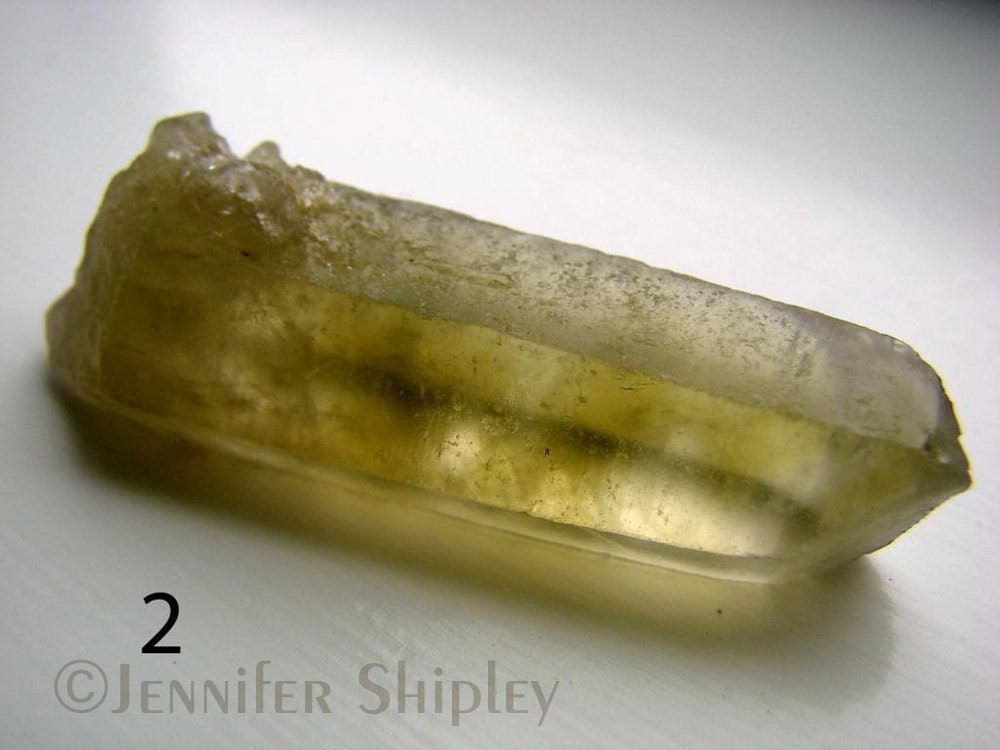
| Unheated Smoky Lemon Citrine |
Summary of Citrine's Healing Properties
Citrine is a yellow variety of quartz crystal and has a Mohs hardness of 7. Also called lemon citrine and (sometimes lemon quartz), it is known in the metaphysical realm for its ability to promote prosperity and abundance. Energetically, it helps dissipate negativity and promotes optimism. Citrine aids in manifestation by inspiring confidence and motivation, and by aligning the user with his/her true will. Citrine is linked with the sun and acts on the solar plexus chakra. Unlike heated-amethyst citrine, lemon citrine does not require energetic cleansing. It is a stubbornly positive stone, inspiring a positive outlook and an, "I can" attitude.
The Energetic Nature of Unheated Lemon Citrine
Unheated lemon citrine has a very different energetic signature than heat-treated amethyst. One of the reasons many practitioners consider it a superior manifestation stone is the presence of lithium. In natural citrine, trace lithium and aluminum substitutions within the crystal lattice create a uniquely stable and self-sustaining color center. Energetically, this translates into a stone that does not easily absorb or hold stagnant emotional patterns. Unlike heat-treated amethyst or even clear quartz, unheated citrine rarely needs cleansing. It does not tend to “hang on” to negativity. Its baseline state is remarkably steady and positive.
Lithium is widely associated with emotional stabilization and elevation. While the lithium in citrine is not present in medicinal doses, its structural presence within the quartz lattice contributes to what many experience as a gently uplifting, mood-stabilizing energetic quality. Citrine feels stubbornly positive. It resists emotional heaviness. That same quality is what makes it protective, much like smoky quartz, but instead of transmuting darkness, citrine maintains brightness.
Manifestation begins with thought. Thought becomes feeling. Feeling shapes perception and action. Whether one frames this through metaphysics, psychology, or quantum models of consciousness, the principle remains the same: what we repeatedly focus on expands in our lived experience. Citrine assists by reinforcing constructive thought patterns. It supports optimism, willpower, and forward momentum. It does not create manifestation for you passively. It helps you maintain the internal state from which manifestation becomes possible.
For this reason, unheated lemon citrine is often considered The True Manifestation Stone. It strengthens personal will, clarifies intention, and helps anchor positivity long enough for it to become embodied action.
There are other yellow quartz varieties, including golden healer, tangerine/iron-stained quartz, ferruginous quartz, and some amphibole quartz, all colored by inclusions, but these are not citrine. For a gemologist, it does not matter what elements are causing the yellow color inside of citrine, as long as it is transparent color zones, not inclusions or coatings. However, for someone who is using citrine for metaphysical purposes, the color is not the only thing that matters. We care about what elements and processes cause that color — whether it's iron and heat, or lithium and aluminum — as they each have different healing properties.
How Citrine Forms: Three Common Pathways
Many websites and books claim that iron is what colors both natural citrine and amethyst, while at the same time listing the healing properties for lemon citrine. There are actually three different types of citrine:
- Heat-treated Amethyst - Most citrine on the market is amethyst crystals that are heat-treated to product a yellow crystal. They are colored predominantly by iron and have healing properties similar to amethyst.
- Naturally Heated-Citrine - These are amethyst that have been exposed to natural heat. This is a very rare occurrence. Healing properties are similar to amethyst or heat-treated amethyst, but can have their own unique nuance.
- Aluminum Citrine, or Lemon Citrine. Color is not caused by iron and doesn't require heating for its yellow color. Healing properties are very different from those of amethyst. This is the most highly sought after variety for those who use crystals for healing. This is considered the true manifestation stone, activating the solar plexus chakra. This is a rare stone.
In quartz, trace elements such as aluminum or iron substitute for silicon within the crystal lattice. These substitutions create charge imbalances that are compensated by ions like lithium or hydrogen. When exposed to natural radiation, these impurity complexes form transparent color centers that produce amethyst, smoky quartz, or citrine coloration. Heating can alter or destroy some of these color centers, changing the crystal’s color without changing its chemical composition. In amethyst, this results in a yellow crystal. In citrine or smoky quartz, the color simply fades. I discovered that the hard way when soldering citrine crystals and the stones got too hot. The smoky color disappeared, and only a light yellow remained.
Note that the elements that color smoky quartz and citrine are the same, it is just the ratio of these elements that determines whether the color zone is yellow, green, brown or black or a combination of these. This is why both of citrine and smoky quartz can come out of the same mine.
One More Variety: Ametrine
Ametrine is a variety of amethyst where it is either partially heated, or part of it was re-irradiated. I have seen contradicting opinions as to whether it ever occurs naturally, but I have read that it can be created by heating amethyst, then protecting part of the crystal with lead and re-irradiating it. I imagine the conditions for this to happen naturally would be quite rare.
So How Can You Tell Which Type of Citrine You Have?
Since amethyst is found in abundance, 99% of citrine sold on the market is heat-treated amethyst. Unfortunately, with all the heat-treated amethyst flooding the market, it can be challenging to find real unheated lemon citrine. And there is a lot of misinformation out there making it even more difficult to know what to look for. What makes it even worse is that most heating happens at the mine, therefor many sellers do not even realize it is heated. Brazilian mining and export law does not require disclosure of treatments at the mine level, leading the seller to unknowingly pass along bad information.
And to add to the confusion, some books and resources will also list the healing properties of lemon citrine, and show the photos of heated citrine. Others will accurately show each as having their own unique properties, but not really explain how to tell them apart. If you are looking at citrine for its metaphysical properties, you will need to be able to identify whether it is lemon citrine, or heated-amethyst citrine, because they do not have the same healing properties. Heated-amethyst "citrine" properties are actually more similar to amethyst.
Color Ranges and What They Can (and Can’t) Tell You
The most common property that people look at when trying to identify minerals is color, and while this is usually inadequate on it's own, there are some distinct differences in color between most lemon citrines and heated amethyst citrines. Now, there are always exceptions to these rules, but most crystals on the market will fit into these color zones.

|
| Cool Colors On the Left - Warm Colors On the Right |
Imagine a rainbow/spectrum with a line going right down the center of the color yellow. From this line, the colors on the right gradually get warmer, and to the left the colors gradually get cooler. This illustrates the color ranges of most heated-amethyst and lemon citrine. To the right of the line is heated-amethyst and to the left is lemon citrine.

|
| Classic Warm Hue of Heated Amethyst Citrine |
Now I realize that this doesn't realistically represent the exact colors of the crystals, but I hope it illustrates my point. Most heated amethyst citrine is warmer in color than lemon citrine. Even if the color is yellow, most lemon citrine ranges cooler in color than heated amethyst, and although heated-amethyst can also be yellow, most is orange, red, champagne, amber or brown. This alone will help you differentiate a good percentage of specimens on the market.
Notice how all of the lemon citrine specimens I have posted range a bit cooler on the spectrum, even the ones that aren't smoky at the top of this article? Also, if it is a smoky olive-yellow, I am quite sure it is not possible to be heated-amethyst, as heating destroys smoky color.
Now there are exceptions to this. There are many crystals that are champagne colored, or sit right in the middle of yellow, and it can be quite hard to distinguish whether they are heated-amethyst or lemon citrine. There are also some very rare unheated citrines with an intense warm yellow hue. It can be very tricky to know if these are the very rare naturally heated variety or lemon citrine. These situations require you to utilize other characteristics, such as crystal habit and dichroism (introduced at the end of the article.)

|
Untreated Amethyst Cluster From Brazil
|
Crystal Shape and Growth Habit (One of the Most Reliable Clues)
Very simply put, crystal habit is the shape the crystal grows in. Most amethyst on the market have a very distinct shape. Now, this shape won't be present in 100% of heated-citrine crystals, but it has a high probability of helping you differentiate most heated-amethyst from lemon citrine.

|
| Heat-Treated Amethyst Cluster From Brazil |
Dog-Toothed Crystals
Brazil is by far the largest supplier in the world of both amethyst, and heated-amethyst citrine. Fortunately, this citrine is very easy to identify by shape. The majority of the amethyst produced grows in geodes or clusters. Those are then broken up and sold as either small clusters or single crystals.

|
Heated Amethyst from http://www.the-vug.com/vug/vugfakes.html
Notice the orange color and Dog-Tooth shape?
|
Because the crystals grow so tightly packed together, the hexagonal sides (called m-faces) that would normally run roughly parallel along the crystal toward the termination (point) are often distorted beyond recognition. The neighboring crystals cause severe growth interference of the crystal habit, resulting in a jagged diamond shaped crystal, called a "dog-toothed" crystal. If a raw crystal has this shape, it is safe to conclude that it is heated amethyst citrine.

|
| Dog-Tooth Shaped Amethyst Crystals |
Lemon citrine can grow in clusters, but typically they still have m-faces, similar to smoky quartz. If it has hexagonal sides, that either run parallel or taper toward the termination, you can rule out most Brazilian heated-amethyst citrine.
If the citrine crystal gets fatter as it get's closer to the termination, most likely it is heated-amethyst citrine from a geode.

|
|
Brazilian Heated Citrine - No M-Faces, Widest At Termination
|
Distribution of Color Within the Crystal
Another characteristic common in amethyst and heated-citrines from clusters is the tendency to be white at the base and dark at the termination. Periodically natural lemon citrines do have this color zoning, but nearly all heated-citrine from geode have this trait.

|
|
Dog-Toothed Heated Citrine with White Base & Orange Termination
|
Unheated citrine is commonly more even colored throughout the crystal, or it could be darker at either the termination or the base, or it can have phantoms. But the majority of amethyst from geodes are dark at the termination and light at the base. This trait alone can't identify which crystal you have, but used in combination with the other characteristics you can identify most heated-amethyst citrine.
Dichroism: The Coolest Citrine Crystal Test
If you’ve gotten to this point and still can’t tell whether your specimen is lemon citrine or heat-treated amethyst, don’t worry. Some stones fall right on the middle of the yellow spectrum, are champagne-colored, or are cut so you cannot see the crystal habit and color zoning.
One additional trait that can help is dichroism, a subtle color shift visible when a crystal is viewed from different directions. While quartz is not strongly dichroic overall, some natural lemon and smoky citrines can show a weak directional color change, often shifting between yellow and greenish-yellow or smoky tones as the crystal is rotated in the light.
Amethyst, including heat-treated amethyst sold as citrine, does not display true dichroism. Its color appears uniform regardless of viewing direction. For this reason, a noticeable directional color shift can be a useful supporting clue for identifying unheated citrine, especially when combined with crystal habit and color distribution.

|
| My First Ever Citrine (Heat-Treated Amethyst) |
A simple way to check for dichroism is to view the crystal against a white LCD screen and slowly rotate it. Often natural lemon and smoky citrines will show a subtle directional color shift, while amethyst and heat-treated amethyst remain uniform from all angles.
I will be filming a video on how to do a dichroism test soon, so check back for that, plus for a few more tidbits I ran out of time to complete. I removed all of my links to lemon citrines for sale by various vendors because they were from 14 years ago - this rewrite was long overdue. Hopefully it is a lot easier to get through and the new knowledge I have gained will help you find your perfect lemon citrine crystal. If you are still having issues, you can contact me on
Etsy, and I would be happy to help you find one. Also, please visit me on YouTube at
https://www.youtube.com/@doodlepunkart
where I am teaching rockhounding, geology, crystallography, lapidary and wire-wrapping.

|
| Amethyst Cluster |
Thanks so much for reading.
If you liked this, you might also enjoy:
Red Phantom Quartz and the Important Work of Grounding
Carnelian Metaphysical Properties and Gemstone Information
Black Tourmaline (Schorl) Metaphysical Properties and Gemstone Information

|
| Dog Toothed Amethysts |
One of my favorite quartz websites has a page on citrine that explains the science behind its formation in greater detail:
http://www.quartzpage.de/citrine.html

|
| Dog Toothed Brazilian Amethyst |

|
| Dog Toothed Heated Citrine - White Base |